CBRS (3.5 GHz) | Indoor Coverage Intelligence
Comprehensive guide to Citizen Broadband Radio Service (CBRS) spectrum sharing, Private LTE, and CBRS deployment.
CBRS (3.5 GHz)
Citizen Broadband Radio Service opens 150 MHz of mid-band spectrum (3550–3700 MHz) for dynamic sharing between federal incumbents, licensed operators, and enterprise users. RFWEL Engineering is a certified CPI delivering turnkey CBRS and Private LTE projects.
- Spectrum: 150 MHz
- Frequency: 3.5 GHz
- CPI Certified: RFWEL
main content
Citizen Broadband Radio Service (CBRS) is an opened-up 150 MHz channel for spectrum sharing, that was otherwise mainly used by military ships, ground radars, and fixed satellites. CBRS operates in the 3.5 GHz spectrum (3550 – 3700 MHz) which is part of the C-band spectrum.
Unlike traditional licensed LTE, CBRS uses a three-tier spectrum-sharing framework that lets enterprises deploy private LTE/5G networks without purchasing nationwide spectrum. SAS automation, CPI verification, and ESC sensors ensure incumbent protection while maximizing channel reuse.
- Supports Private LTE, campus Wi-Fi augmentation, industrial IoT, and FWA backhaul.
- PAL licensees receive local interference protection; GAA users opportunistically tap unused channels.
- RFWEL's CPI services streamline regulatory onboarding and CBSD commissioning.
- Note: CBRS (Citizens Broadband Radio Service) at 3.5 GHz should not be confused with CB Radio (Citizens Band Radio) which is a two-way voice system at 27 MHz typically used by truckers.
text content
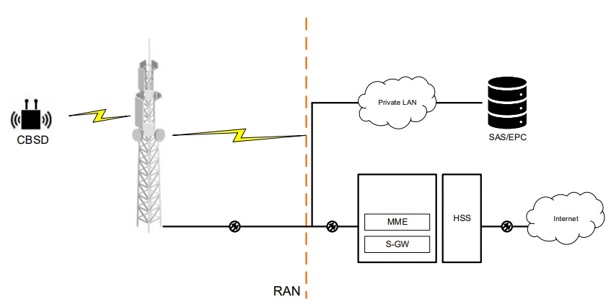
When CBRS is used for Private LTE, it is similar to traditional LTE in that it uses Evolved Packet Core (EPC) to access the provider's services. This includes the Mobile Mobility Equipment (MME), Service Gateways (S-GW), and Home Subscriber Station (HSS). The only difference comes in communication between the eNodeB (CBSDs) and the user equipment (UE) or end-user devices (EUDs).
In LTE, each provider uses its own unique frequency bands and cannot share infrastructure. For CBRS, a common 3.5 GHz spectrum is used in a dynamic shared spectrum setup (similar in some ways to TV White Space (TVWS) or Licensed Shared Access (LSA) in Europe).
RFWEL Engineering is a certified professional installer (CPI) of CBRS systems. You can contact us to know how best to deploy CBRS fixed wireless projects like campus hotspots, personal and small business hotspots, and backhaul and other Fixed Wireless Access applications.
text content
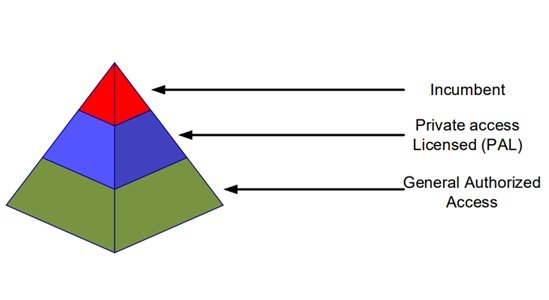
There are three tiers in the CBRS shared spectrum:
image section
card grid
- Incumbent Users U.S. Navy shipborne radar, ground-based radar, satellite earth stations, and grandfathered 3.65 GHz WBS networks retain top priority and can use any channel.
- Priority Access Licensed (PAL) Licensed operators granted 10 MHz channels between 3550–3650 MHz. They preempt GAA users and receive interference protection within their census tracts.
- General Authorized Access (GAA) Unlicensed deployments using available spectrum not occupied by higher tiers ideal for private LTE, campus hotspots, small businesses, and fixed wireless links.
image section

Core Building Blocks
CBRS has the following key components:
- Spectrum Access System (SAS) Cloud controller that authorizes CBSD transmit parameters, protects incumbents, and dynamically assigns spectrum akin to TVWS geo databases.
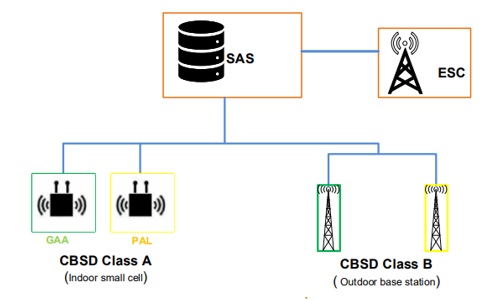
- CBSD Classes A & B Category A ≤ 30 dBm EIRP for indoor/outdoor installs below 6 m HAAT. Category B ≤ 47 dBm, outdoors only, and must be commissioned by a Certified Professional Installer (CPI).
- Environmental Sensing Capability (ESC) Coastal sensor networks that detect incumbent activity and notify SAS to clear CBSDs from affected channels within minutes.
- Domain Proxy & CPI Proxies aggregate legacy radio communications to the SAS, while CPI-certified installers (RFWEL Engineering) validate CBSD coordinates, antenna heights, and FCC compliance.
CBSD Categories
- Category A CBSD Has max EIRP of 30 dBm and can be used indoors or outdoors. If outdoors, antenna must be less than 6 meters HAAT.
- Category B CBSD Has max EIRP of 47 dBm and can only be used outdoors. The antenna must be less than 6 meters HAAT. Must be installed by a CBRS Certified Professional Installer (CPI) – RFWEL Engineering is a CBRS CPI.
text content
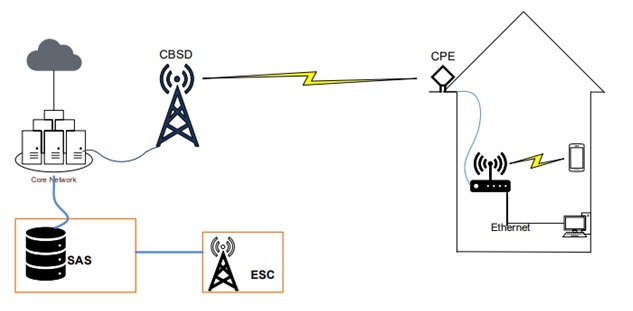
See below sample CBRS architecture:
image section
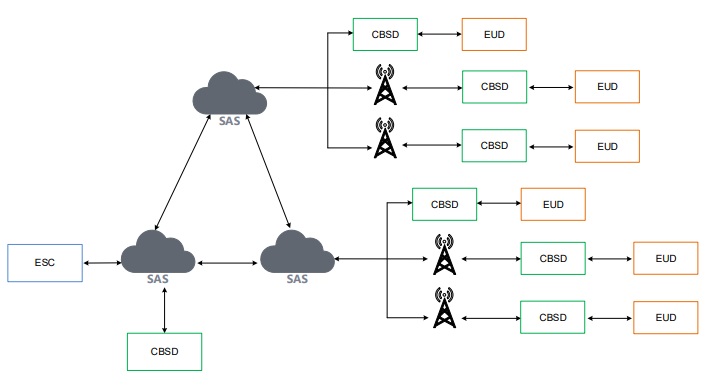
image section
text content
CBRS devices must generally follow the rules below:
- Comply with SAS instructions within 5 minutes of receipt.
- Report location changes to SAS within 60 seconds.
- Support two-way communications on authorized channels only.
- Installations must be performed by a certified CPI; RFWEL Engineering is a licensed CBRS CPI.
- During power-up, CBSDs must report GPS, height, category, FCC ID, and PAL/GAA status.
image section
text content
CBRS for private LTE is based on TD-LTE with one difference being different spectrum emissions mask requirements. The CBRS band is LTE Band 48. The UL/DL TDD configuration needs to be localized because of possibly non-planned deployments.
text content
Signal attenuation, or the loss of signal strength in coax or networking cables, is typically measured in a logarithmic scale, i.e., decibels (dB). Cable attenuation or loss is directly proportional to the frequency and the length (i.e., the longer the cable the higher the loss or the higher the frequency the higher the loss).
CBRS radios operate in the 3.55 to 3.7 GHz band (3550 – 3700 MHz) thereby posing a greater signal loss challenge than other LTE/NR radios that operate at lower frequency bands. It is therefore important to choose the right low-loss cable when the cable run is longer than say about 100ft.
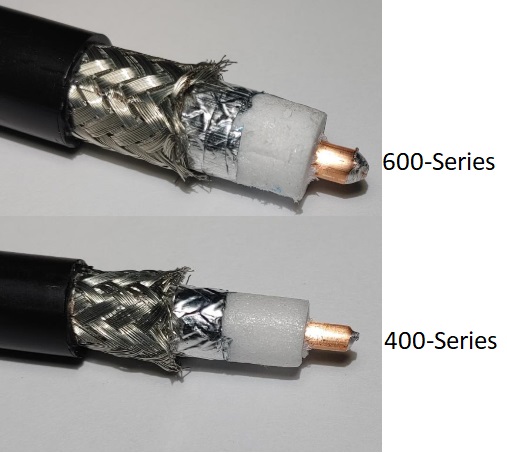
A suitable option for long cable runs is the 600 series cable which has a lower attenuation compared to the 400-series making them suitable for longer runs. This way you can achieve the desired EIRP without having expensive and bulky high gain antennas.
image section
Cable Loss at 3.7 GHz
Mid-band CBRS deployments suffer higher coax attenuation than low-band LTE. Use low-loss cabling such as LMR-600 for long runs to preserve CBSD EIRP. Values below show attenuation per 100/200/300 ft at 3.7 GHz.
Cable Loss at 3.7 GHz
| Cable Type | 100 ft | 200 ft | 300 ft |
|---|---|---|---|
| 600-Series | 6.2 dB | 12.3 dB | 18.5 dB |
| 400-Series | 9.4 dB | 18.6 dB | 27.8 dB |
| 240-Series | 17.7 dB | 35.2 dB | 52.7 dB |
text content
Need pre-terminated cable assemblies? Explore 600-series and 400-series custom builds on RFWEL shop or our curated Amazon listings. RFWEL can custom build your custom cable with appropriate connectors and pigtails to interface your radio equipment and antennas. We also offer cables suitable for different environments, e.g., outdoor UV protected, plenum-rated cables, flexible cables for tight spaces, etc.
text content
The 3650 –3700 MHz service was created in 2005 when FCC opened this spectrum for Wireless Broadband services (WBS). However, with the introduction of the CBRS spectrum, the WBS devices need to shift to use the CBRS SAS (Spectrum Access System).
WiMAX radios were using the 50 MHz WBS band, i.e., 3.65-3.7 GHz (3650-3700 MHz) (other WiMAX radios, e.g., Clearwire which was later acquired by Sprint, used the 2.5 GHz band (LTE Band 41).
After the FCC approved CBRS SAS in 2015, radios operating in the WBS band were treated as incumbents and were grandfathered/protected from interference until April 17, 2020. WBS providers now have to shift and operate on a GAA (General Authorized Access) basis as other lowest tier CBRS devices.
Unlike WiMAX which was lightly licensed in the WBS band, GAA users in the CBRS band of the SAS system are unlicensed and this provides opportunities for operators, and businesses to increase their wireless coverage with CBRS devices.
The comparison below shows a typical WiMAX setup for Fixed Wireless Access (FWA) and an equivalent CBRS setup for much faster and more flexible FWA.
image section
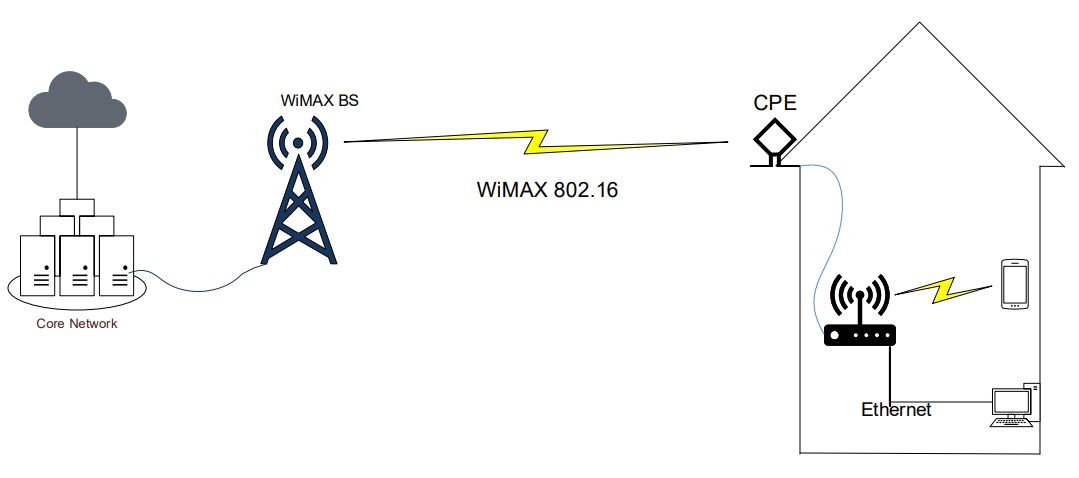
image section
text content
With CBRS, the technology can achieve more than 100 Mbps depending on the distance from base stations. An added advantage of the spectrum sharing (SAS) system is that a GAA device can utilize additional frequencies up to around 150 MHz if PAL devices and incumbents are not utilizing those frequency bands.
CBRS Defining Bodies
- United States Federal Communications Commission (FCC) Regulatory agency defining Part 96 Rules
- Wireless Innovation Forum (WinnForum) Industry-led group defining requirements and protocols for use with CBRS. Members include SAS operators, network operators, and equipment manufacturers.
- CBRS Alliance Group supporting LTE-specific interests in CBRS. They administer OnGo certification program.
Incumbent Users
- Military Ship-borne Radar Operates in the coastal areas. They may have significant activities in specific areas like San Diego. image
- Military Ground-based Radar Occasional Operations at various military bases around the country image
- Fixed Satellite Service Earth Stations (Receive only) Few number of sites in the country operating in receive mode in the CBRS band. image
- Wireless Broadband Services Various sites operating around the country. They are transitioned to operate as CBRS users (GAA or PAL) image

text content
Contact an RFWEL CBRS Certified Professional Installer (CPI) to learn more about how you can migrate your legacy WBS system to CBRS or how you can use CBRS on your next greenfield Fixed-Wireless Access (FWA) project. You may also reach us at +1.480.218.1877 Option 2.