Distributed Antenna Systems (DAS), Cellular Signal Boosters & CBRS Solutions
Learn how Distributed Antenna Systems (DAS), cellular signal boosters, and CBRS enable reliable indoor wireless coverage for large buildings, stadiums, airports, and enterprise environments.
Distributed Antenna Systems (DAS)
Scalable indoor wireless coverage solutions for enterprise, public venues, and mission-critical environments.
- Coverage Types: Active DAS, Passive DAS, CBRS (Private LTE/5G)
- Supported Venues: Stadiums, Airports, Hospitals, Offices
- Networks: LTE, 5G NR, Private LTE (CBRS)
main content
A Distributed Antenna System (DAS) is designed to distribute cellular wireless signals throughout a defined area such as large buildings, office complexes, stadiums, hospitals, convention centers, and airports.
DAS improves indoor signal strength, coverage uniformity, and network capacity where macro cellular signals alone are insufficient.
There are two primary types of DAS deployments: Active DAS and Passive DAS, each suited for different coverage, capacity, and budget requirements.
text images content
In active DAS systems, the distributed components (remote nodes) require a power source to operate. Although generally more expensive than passive DAS, this is a preferred solution in football stadiums, airports, convention centres, or other high traffic areas that require wide-area network coverage and large capacity.
Consider CBRS (private LTE, private NR) as a future-proof alternative to Active DAS. Learn More
text images content
Passive DAS systems utilize passive (unpowered) components like splitters, coaxial cables, and diplexers to redistribute signal.
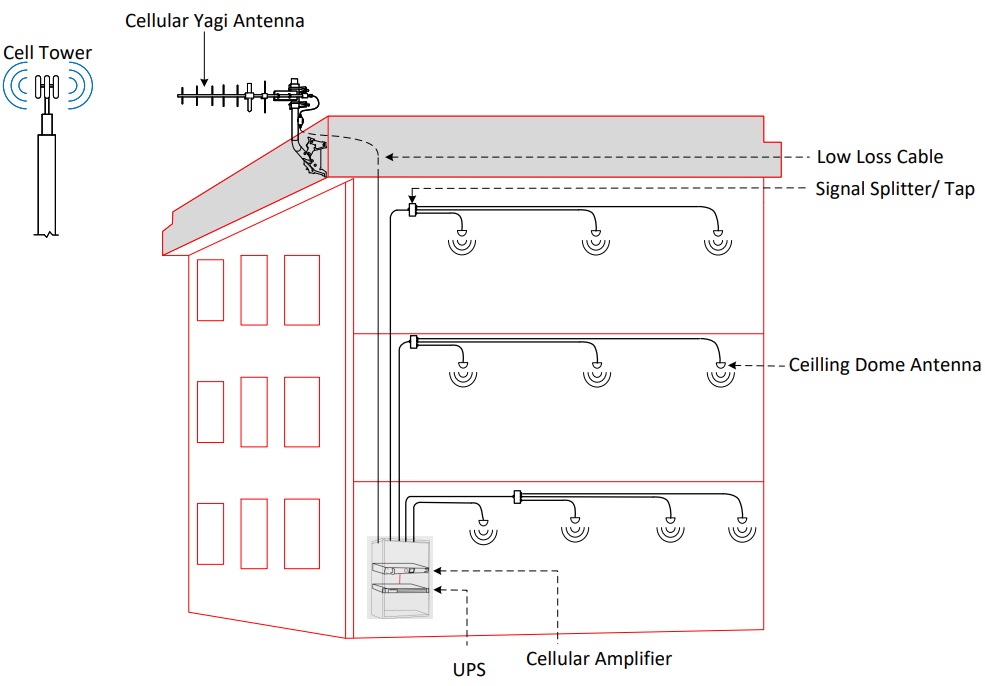
Typically, passive DAS uses a bi-directional amplifiers (BDA) (also known as repeaters) to re-broadcast an amplified or boosted signal from a macro cellular network. Generally, an outdoor antenna (donor antenna) is connected via low-loss coaxial cable to the BDA, and indoor distributed antennas connected to the BDA re-radiate the boosted signal indoors.
Sample drawing for passive DAS system.
Care must be taken when designing and deploying passive DAS systems. Common pitfalls include:
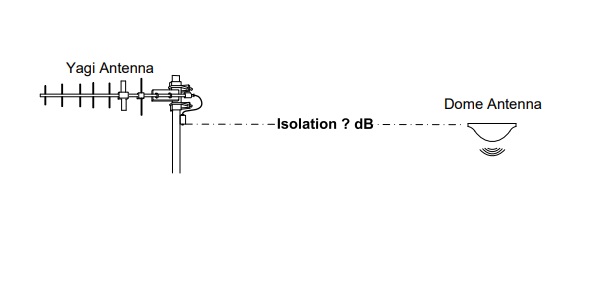
• There should be proper isolation between donor antenna and indoor antenna to prevent positive feedback which can cause severe interference to other users.
• Not carefully considering cable attenuation based on cable type and frequency band of interest. Learn More.
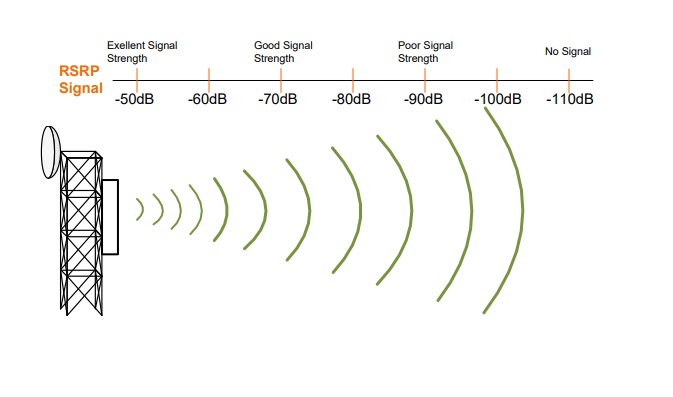
• Proper RSRP or RSRQ/SINR values.
Signal Strength Guide (RSRP)
Signal quality Guide (RSRQ)
| RF Conditions | RSRP | RSRQ |
|---|---|---|
| [object Object] | [object Object] | [object Object] |
| [object Object] | [object Object] | [object Object] |
| [object Object] | [object Object] | [object Object] |
| [object Object] | [object Object] | [object Object] |
text images content
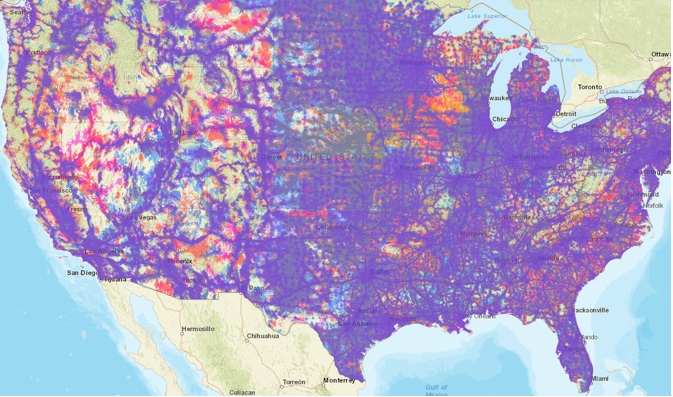
• Selecting amplifiers that cover the specific MNOs bands. Check out LTE bands and NR bands. More on FCC LTE map.
FCC LTE Map
• Too many or poorly placed splitters/taps and/or poor cable termination or routing. Learn more.
View DAS Devices and other In-Building Fixed Installation devices supported in RFWEL's Wireless Device Information website:
Please contact an RFWEL indoor-coverage specialist for design and installation assistance.