Power over Ethernet (PoE) Solutions | IEEE 802.3af, 802.3at & 802.3bt
Explore Power over Ethernet (PoE) solutions including PoE, PoE+, and PoE++ switches and injectors. Deliver data and power over a single Ethernet cable for wireless, security, and smart infrastructure deployments.
Power over Ethernet (PoE) for Wireless & Networked Devices
Simplify power delivery to wireless access points, IP cameras, sensors, and IoT devices by transmitting power and data over a single Ethernet cable.
- IEEE Standards: 802.3af, 802.3at, 802.3bt
- Up to 100W per Port: High-power PoE++ support
- Single-Cable Deployment: Power + Data
main content
Power over Ethernet (PoE) is a technology that enables electrical power and data signals to be transmitted simultaneously over standard Ethernet cabling.
PoE eliminates the need for separate power supplies, reducing installation complexity and improving deployment flexibility especially in outdoor and remote wireless environments.
text images content
PoE uses Power Sourcing Equipment (PSE), such as PoE switches or injectors, to deliver power to Powered Devices (PDs) including wireless access points, IP cameras, routers, and gateways. The PSE automatically detects compatible devices and delivers the appropriate voltage and current safely over the Ethernet cable.
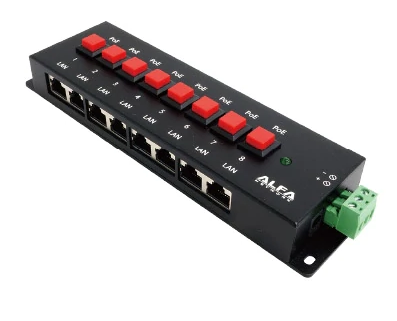
APoE08 8 Port Power Over Ethernet (POE) Switch
text images content
There are several standards for POE, which specify the maximum amount of power that can be delivered over Ethernet cables. Here are the four main POE standards: IEEE 802.3af (PoE), IEEE 802.3at (PoE+), IEEE 802.3bt (PoE++, 4PPoE, or Type 3/ 4 PoE), and UPoE (Cisco Ultra-PoE)
1. IEEE 802.3af (PoE):
- Power Delivery: Up to 15.4W of DC power per port (min of 12.95W guaranteed at the powered device).
- Supply voltage of 44-57V DC, current, 0.1-0.35A
- Pin Configuration: Mode A or Mode B.
- Powering Options: Delivers power over the same pairs used for data transmission (pins 1, 2, 3, and 6 in Mode A or pins 4, 5, 7, and 8 in Mode B).
- Ethernet Cable: Utilizes Category 3 or higher-grade cables (e.g., Cat 5, Cat 5e, or Cat 6) for power and data transmission.
- Typical Use Cases: IP phones, wireless access points, and low-power network devices.
2. IEEE 802.3at (PoE+):
- Power Delivery: Up to 30W of DC power per port (min of 25W guaranteed at the powered device).
- Supply voltage of 50-57V DC, current 0.01-0.6A
- Pin Configuration: Mode A or Mode B.
- Powering Options: Supports both Mode A and Mode B power delivery.
- Ethernet Cable: Utilizes Category 5e or higher-grade cables (e.g., Cat 6 or Cat 6a) for power and data transmission.
- Typical Use Cases: High-power wireless access points, pan-tilt-zoom (PTZ) IP cameras, LCD displays, biometric sensors and advanced network devices requiring higher power levels.
Note: PoE+ (IEEE 802.3at) is backwards compatible with POE (IEEE 802.3af) meaning it will power even legacy POE power devices.
3. IEEE 802.3bt (PoE++, 4PPoE, or Type 3/ 4 PoE):
- Power Delivery - Provides two power levels:
- Type 3: Up to 60W of DC power per port (min of 51W guaranteed at the powered device).
- Type 4: Up to 100W of DC power per port (min of 71W guaranteed at the powered device).
- Pin Configuration: Mode A or Mode B.
- Powering Options: Supports both Mode A and Mode B power delivery.
- Ethernet Cable: Utilizes Category 5e or higher-grade cables (e.g., Cat 6 or Cat 6a) for power and data transmission.
- Typical Use Cases: High-power devices such as video conferencing systems, lighting systems, and industrial applications.
Note: (IEEE 802.3bt) is backwards compatible with both IEEE 802.3af and IEEE 802.3at meaning it will power even legacy POE power devices.
4. UPoE (Cisco Ultra-PoE):
This is a proprietary standard developed by Cisco that provides up to 60 watts of power per port. It is similar to IEEE 802.3bt, but it uses a different power management system.
Note that the power sourcing equipment (PSE), such as a PoE-enabled switch or injector, must comply with the corresponding PoE standard to ensure compatibility with powered devices (PDs). Additionally, PDs must also adhere to the specific PoE standard requirements to receive power safely and efficiently over Ethernet cables.
PoE Power Classification Table
These standards allow network administrators to power a wide range of devices through Ethernet cables, reducing the need for separate power supplies and making network deployments more flexible and efficient.
PoE Power Classification Table
| Type | Standard | PD Min. Power Per Port | PSE Max. Power Per Port | Cable Category | Power Over Pairs |
|---|---|---|---|---|---|
| Type 1 | IEEE 802.3af | 12.95W | 15.4W | Cat5e | 2 pairs |
| Type 2 | IEEE 802.3at | 25W | 30W | Cat5e | 2 pairs |
| Type 3 | IEEE 802.3bt | 51W | 60W | Cat5e/ Cat6 | 2 pairs class 0-4, 4 pairs class 5-6 |
| Type 4 | IEEE 802.3bt | 71W | 100W | Cat5e/Cat6 | 4 pairs class 7-8 |
text images content
When selecting PoE equipment, consider:
- Required PoE standard and power class
- Total power budget across all ports
- Cable category and length
- Indoor vs outdoor installation requirements
- Compatibility with wireless radios and cameras
text images content
PoE is widely used in:
- Outdoor wireless access points
- IP surveillance and PTZ cameras
- Smart city and street infrastructure
- IoT sensors and gateways
- Enterprise and industrial networks
Expert Support
Contact an RFWEL Power & Wireless Specialist for guidance on selecting PoE solutions for outdoor wireless, surveillance, and smart infrastructure deployments.