Wireless IoT | Wireless Monitoring & Control
Comprehensive guide to Wireless IoT protocols, devices, and solutions for industrial and home automation.
Wireless IoT
Internet of Things (IoT) enables connectivity and communication between devices via the Internet, gaining momentum especially with the introduction of 5G. Wireless IoT devices allow "things" to transmit and receive data wirelessly, untethered to wiring infrastructure.
- Protocols: 8+ Types
- Range: Short to Long
- Power: Low Power
main content
Wireless IoT devices allow the "things" in Internet-of-Things to transmit and receive data wirelessly allowing them to be untethered to wiring infrastructure. Different IoT communication protocols have been developed to meet the low-power, wide-area coverage, and simple (low-cost) needs of IoT devices.
These include communication protocols such as variants of Wi-Fi (HaLow), Z-Wave, Bluetooth, Bluetooth Low Energy (BLE), Zigbee, LoRaWAN, and Cellular-IoT (CIoT) technologies include Narrow-Band IoT (NB-IoT) and LTE Category M (LTE-M).
- Low-power, wide-area coverage for remote monitoring and control
- Simple, cost-effective solutions for industrial and home automation
- Support for machine-to-machine (M2M) communication and SCADA applications
IoT Protocols
- Wi-Fi: Although IoT devices can use standard 2.4GHz and 5GHz bands including WiFi-4, WiFi-5, and WiFi-6/6X (802.11 n/ac/ax), a new 802.11 protocol (IEEE 802.11ah also known as Wi-Fi HaLow) is being developed specifically for IoT applications. Wi-Fi Halow (802.11ah) operates in the Sub-1 GHz and offers a longer range of operation (~ 1 Km). Various enhancements to the 802.11 allow 802.11ah stations to utilize low power (allowing for extended battery life) and long-range (allowing for use in remote areas).
- Bluetooth and Bluetooth Low Energy (BLE): Usually used for short distances and utilizes the ISM bands from 2402 -2480 MHz ISM band. Bluetooth can handle a lot of data but consumes more power compared with BLE. With BLE, they are used for low data transfer with low connections times, about a few mS, and, therefore, can run on battery power for long periods.
- Z-Wave: This is a mesh network, usually used for home automation such as lighting control, security systems, thermostats, windows, and garage door openers. It operates in the 900 MHz unlicensed ISM band.
- ZigBee: This is the 802.15.4 based standard and uses the ISM bands (2.4 GHz, 900 MHz), Has ranges of up to 100 meters but this range can be increased with a mesh network of Zigbee devices comprising of ZigBee coordinator, Zigbee router, and ZigBee end devices.
- LoRaWAN, Sigfox, LoRa: These operate as LPWAN (Low power WAN). LoRaWAN is an 802.15.4g MAC-layer protocol. LoRaWAN links the signal to the application/s, so will contain the data transfer layer as well, enabling you to send the data to any device already connected to the cloud. Sigfox is an ultra-narrowband technology. LoRa uses proprietary frequency-modulated chirp which utilizes coding gain. LoRa is the signal and only contains the PHY layer protocol. They enable communication in lower power WAN connecting IoT devices via a central network server. They have industrial and home applications. In the US, these use the ISM 900 MHz band and 868 MHz in Europe.
- NB-IoT, LTE-M: These are competitors for Sigfox and Lora in the LPWAN space. LTE-M offers speeds of 1 Mbps (3GPP Release 13) to 4 Mbps (3GPP Release 14) for IoT applications. NB-IoT focuses bandwidth to a single narrow band of 180 kHz. They offer lower speeds (26 kbps -127 Kbps) than the LTE-M.
Protocol Comparison
Different sensors have different ranges depending on the protocol used. See the table below for comparison.
Protocol Comparison
| Protocol | Range | Data Rate | Latency | Band | Type |
|---|---|---|---|---|---|
| Wi-Fi HaLOW | Low | Long | Moderate | Sub-1 GHz | Unlicensed |
| Wi-Fi 5 and 6 | Moderate | Moderate to long | High | 2.4 & 5 GHz | Unlicensed |
| LTE Cat M2 | Low | Moderate to long | Moderate | LTE/5G-NR | Licensed |
| LTE Cat NB2 | Very low | Long | Low | LTE/5G-NR | Licensed |
| LoRa | Very low | Long | Low | Low | Unlicensed, Proprietary protocol |
| Sigfox | Very low | Long | Very low | 800 & 900 ISM | Unlicensed, Proprietary protocol |
| Bluetooth Low Energy | Very low | Short | Low | 2.4 GHz ISM | Unlicensed |
| 802.15 – ZigBee, Z-Wave Thread, LoWPAN | Very low | Short | Low | ISM Band | Unlicensed |
image section
text content
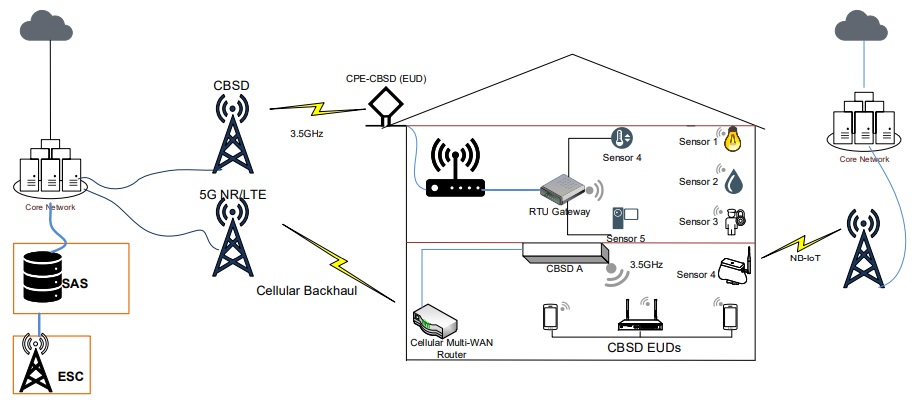
Sensors can connect via a central RTU wirelessly or via wired connection like RS232, and Modbus. The RTU will then connect to the internet via FWA (e.g CBRS, TVWS), PtPs (e.g WiGig, Wi-Fi), Cellular, and DSL.
LTE-M and NB-IOT sensors have inbuilt modems for cellular connectivity. With the arrival of 5G, mMTC (massive Machine Type Communication, 3Gpp release 16) has also been developed. It aims to ensure connectivity of many devices including sensors, with its latency-tolerant design, and other LPWA requirements like more battery life.
text content
There are water sensors that could help in avoiding or detecting flooding in buildings, control, and monitor water flow. These sensors can be placed on floors of basements, or water storages and water conduits.
Other common sensors include HVAC sensors for temperature control, camera sensors that can be connected to private databases for image scanning, motion sensors, as well as GPS sensors/receivers typically used for navigation.
With IoT, machine-to-machine (M2M) communication is important for automation and ease of monitoring and control.
Use the table below to select your SCADA or contact us for a recommendation based on your projects' needs.
Compare Media & Protocol Converters
Compare Cellular Routers & Gateways
text content
At RFWEL Engineering we specialize in long-range BWA applications for various applications including SCADA/M2M, Video Surveillance Backhaul, Data Network Backhaul & Network Bridging Solutions. Please contact an RFWEL Engineer to discuss your application and for recommendations on the equipment required to implement your SCADA, Machine-to-Machine or remote telemetry application. Our experienced team will custom-build your solution using the best-in-class equipment and industry best-known-methods. We are also a Licensed Low-Voltage Wireless Communication contractor (Arizona ROC# 322820) should you need deployment assistance.
partner logos
- GE Digital Energy MDS
- Honeywell
- ABB
- Schneider Electric
Compare Device Mounts
Additional Resources
Use the tables and resources below to select your SCADA or contact us for a recommendation based on your projects' needs.