Long-Range Wireless Links for Industrial Connectivity
Discover high-performance long-range wireless links for industrial networks, remote sites, and mission-critical point-to-point communication.
Long-Range Point-to-Point Wireless Links
Discover high-performance long-range wireless links for industrial networks, remote sites, and mission-critical point-to-point communication.
text images content
RFWEL Engineering is experienced in designing and deploying custom wireless data links to meet your needs. We design and install long-range, high throughput point-to-point (PtP) or point-to-multipoint (PtMP) links for backhaul of remote sites as well as high reliability, enhanced coverage links for sensor backhaul such as for IoT applications.
Broadband Wireless Access Overview
Next-generation broadband wireless IP networks continue to enable a plethora of new applications and as different technologies & protocols struggle to co-exist in the finite wireless space, networks get more complicated & quality of service elusive without a value-added reseller partner to bring it all together. RFWEL is an expert in deploying long-range wireless links to bridge remote locations Learn more
feature grid
- Point-to-Point Point to Point Wireless Network https://www.rfwel.com/us/index.php/wireless-access-sample-solutions image
- Point-to-Multipoint Point to Multi-Point Network https://www.rfwel.com/us/index.php/wireless-access-sample-solutions image
- CBRS CBRS Network Topologies https://www.rfwel.com/us/index.php/cbrs image
- 5G-NR Fixed & Mobile 5G-NR Networks https://wdi.rfwel.com/wireless-standards/5g-nr/ image

text images content
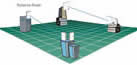
Point-to-Point (PtP)
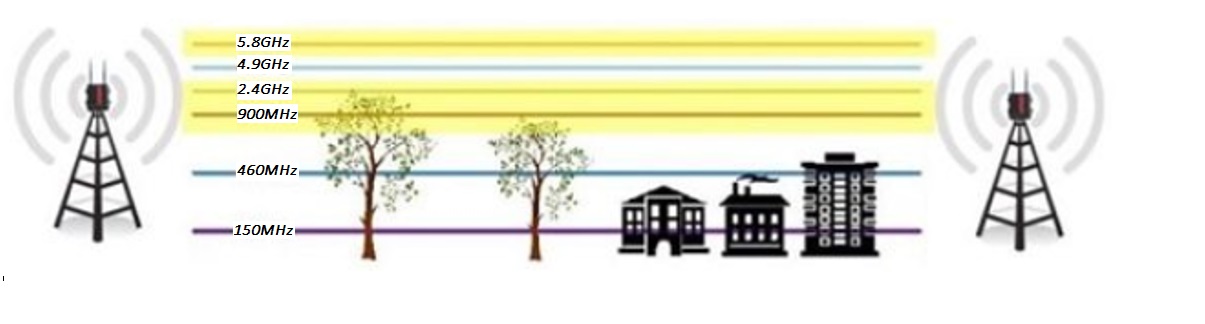
In wireless communication, Point-to-point (PtP) refers to communication/link between two nodes/radios. These nodes communicate via licensed or unlicensed frequencies and using appropriate authentication. The following unlicensed frequencies are commonly used in the United States: 900MHz, 2.4GHz, 5GHz, and 60GHz mmWave.
Other frequencies that can be used for unlicensed PtP include the shared spectrum bands (Citizens Broadband Radio Service) CBRS and Television White-Space (TVWS) bands which employ special architecture to ensure licensed users have preferential access to the shared frequency bands.
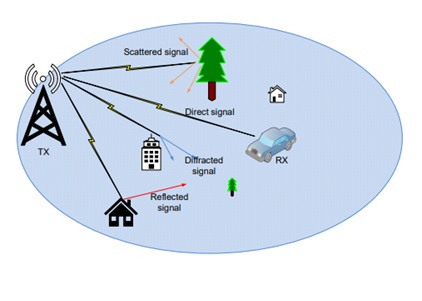
PtP links highly depend on the communication path. Higher frequencies, particularly the millimeter-wave (mmWave) bands above 30 GHz, require line-of-sight (LOS) because radio signals attenuate faster at higher frequencies and any obstacle in the path can cause fatal link distortion.
Other factors that affect wireless signal communication include radio receiver sensitivity, channel bandwidth selected, channel congestion, radio power, and antenna gain which can be used for link budget calculation.
NLOS (Non-line-of-sight) links describe radio links where there is no visual or slightly obstructed path between the transmitter and receiver radio (i.e., obstruction of innermost Fresnel zone by a physical object, e.g., foliage, buildings, hills, etc.). With low and mid-band frequencies like CBRS, 2.4GHz, 900MHz, and TVWS, NLOS communication is possible due to lower attenuation. However, path obstruction reduces the full potential of the link performance.
TVWS and 900MHz band can achieve farther reach compared to other unlicensed bands even with some path blockage. The downside with these bands is that it has small number of channels or lower total bandwidth.
Licensed frequencies include mostly VHF and UHF ranges as well as 4.9GHz for public safety spectrum.
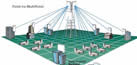
Point-to-Multipoint (PtMP)
While PtP achieves link communication between two nodes, PtMP is used for communication between a distribution node/AP to various station nodes.
The APs usually use sector antennas such as 3600 (Omnidirectional) antennas, 900, 600, or 300. The narrower the azimuth the farther the footprint to connect stations at far distance to the distribution node.
Applications include CBRS networks, TVWS FWA, Wi-Fi networks, and Wireless video surveillance.
Contact an Rfwel Long-Range Wireless Link Specialist for additional information or to discuss your project. Our preferred vendor for proprietary point-to-point and point-to-multipoint radios is Proxim and Cambium.
CBRS
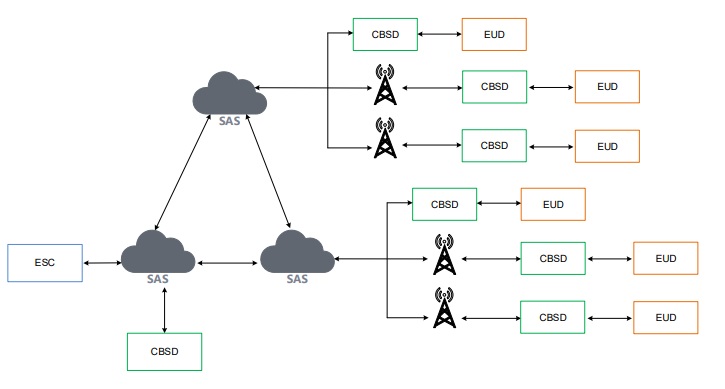
CBRS network is a new spectrum sharing wireless communication service operating in the 3550-3700 MHz band and is being used to deploy private LTE networks especially for FWA (Fixed Wireless Access).
For a complete CBRS network architecture, there should be a Spectrum Access System (SAS) to grant CBRS devices spectrum access, Environmental Sensors (ESC) to detect incumbent operation thereby allowing the incumbents priority use of the shared spectrum over others in the CBRS spectrum, and EPC software for core network communication.
CBSD A or B devices are required for distribution nodes and EUD for end user connectivity to the CBRS network.
With CBRS TDD transmission, speeds of up to 100Mbps over distances several miles is possible with a clear LOS.
5G-NR
5G-NR is achieving faster speeds and could be more suitable for both fixed and mobile communication unlike wired connection that is only used for fixed links.
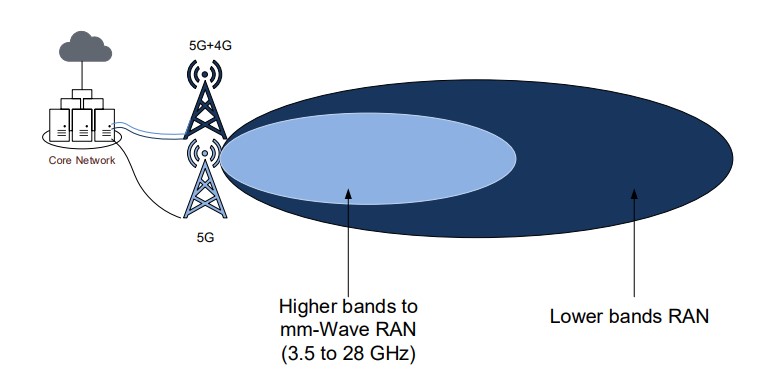
With 5G Frequency Range 2 (FR2, mmWave), speeds of up to 1.8 Gbps are possible but coverage is limited to shorter distances. 5G is overcoming this limitation by applying massive MIMO, beamforming, small cells, and full duplex between tower and 5G NR devices.
The Sub-6 GHz 5G achieves speeds substantially above 4G LTE speeds and has farther reach compared to mmWave.
SCADA, M2M & Telemetry Backhaul
SCADA & Remote Telemetry systems are typically in very remote and often harsh environments. While typical systems don't require much data bandwidth other design parameters such as high availability (interference suppression & redundancy) and low cost (usually require hundreds or thousands of sensor nodes) are very important for this application
Wireless Video Surveillance Backhaul
Remote video/audio transmission. One popular application of long-range broadband wireless access radios is in remote video surveillance. It is now possible to carry 10's to 100's or live video data in real-time over several miles without any quality degradation. Key tradeoffs in video surveillance applications include guaranteeing network latency and system-uptime which often requires using redundant wireless links
Remote & Backup Power
Remote power systems for Industrial SCADA systems. Solar/PV & high capacity rechargeable batteries, used as primary or backup power for remote RTU's. Our SCADA/M2M team works closely with our remote power team to build an optimal remote power system for your application
Antennas, Cables, Towers & Site Accessories
High gain Antennas play a critical role in long-range wireless systems. It is paramount to pay close attention to the antenna specifications not just the gain when designing the long range links. Factors such as beamwidth & front-to-back ratio determine interference immunity (and ultimately system capacity) while factors such as Gain & VSWR affect the link margin and ultimately the range and throughput.
There's more to a long-range link than just the radios and antennas. Factors such as the tower height and design, low-loss cables, lightning surge devices, attenuators, splitters & enclosures are equally important. Rfwel is a licensed communication contractor and experienced wireless system integrator with expertise in deploying wireless link
text images content
RfWeL specializes in offering solutions for large-scale wireless network deployment or long-range wireless ethernet bridging. Here are some of the key equipment manufacturers in this field.